
Post From Expert Insights
Share this post!


Who owns the future of your neighborhood? When housing and asset decisions are left solely to the speculative market and outside investors, communities lose their culture, their stability, and their voice. This traditional system fuels displacement, wealth extraction, and the racial wealth gap.
The solution is the shared equity movement: a strategy for residents to collectively own the assets—the land, the property—and ensure they serve the needs of the community, not the demands of the market. It is a system of ownership designed intentionally to counter extractive practices and center community belonging and self-determination.
Grounding Solutions in Shared Power
This powerful strategy was the focus of a recent session of Build Healthy Places Network’s Community Innovations for Racial Equity (CIRE) initiative, which is funded by The Kresge Foundation and was co-led with the Grounded Solutions Network. CIRE supports BIPOC-led or allied Community Development Corporations in advancing community ownership models and strategic partnerships with mission-driven investors, including healthcare systems, health payors, and Community Development Financial Institutions.
As explained by James Yelen, Director of Technical Assistance at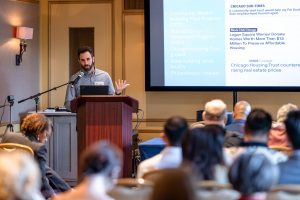 Grounded Solutions Network, shared equity is not merely a program—it is a moral imperative with a civil rights legacy. These models trace their origins directly to the Civil Rights Movement (e.g., New Communities Inc., Albany, GA, 1969), providing a proven strategy for economic justice and collective land ownership that addresses barriers disproportionately affecting families of color.
They are underpinned by three core principles:
Core Models for Lasting Affordability
The Community Land Trust (CLT) is the foundational model, built on the idea of stewardship over speculation. The CLT retains ownership of the underlying land, while residents own the home. A 99-year ground lease binds the two, ensuring the home remains affordable for every subsequent generation. CLTs have a significant racial justice impact, demonstrating high rates of Black, Latino, and Indigenous homeowners, and serving as a critical tool for building generational wealth and preventing displacement. For example, forty-five percent of CLT homeowners are people of color, compared to 26% of homeowners in the broader homeownership market.
The movement encompasses a wider spectrum of community-controlled assets, including:
Mission-Driven Investment and Partner Action
Institutional partners are critical to catalyze this work through specific contributions like land transfers, below-market capital, flexible pooled funds, and policy change. This approach is validated by national models where institutional alignment has led to transformative investment, such as in Boise, ID, where the LEAP Housing Trust  expanded affordable homeownership through a CLT with support from a key health system, Saint Alphonsus Health System. Similarly, Rochester, MN‘s First Homes CLT is thriving due to early backing from the Mayo Clinic. Furthermore, a Community Benefits Agreement in Detroit, MI, emerging from a major redevelopment project led by Henry Ford Health, the Detroit Pistons, and Michigan State University, included vital support for launching a CLT in the surrounding neighborhood. A Robert Wood Johnson Foundation-funded initiative led by Grounded Solutions and National Housing Trust is providing loans and technical assistance to four CLTs in Georgia, Louisiana, Florida, and North Carolina to help them expand their housing portfolios and organizational capacity. These examples clearly demonstrate how a strategic partnership with mission-driven institutions unlocks powerful, community-centered progress.
The Movement in Action: CIRE Partners Build Collective Power
The power of the shared-equity movement is best demonstrated through the bold action of our CIRE partners, who are actively building these new models. In Riverside, CA, Starting Over, Inc., dedicated to ending poverty and incarceration, has launched the Ruchell Cinqué Magee Community Land Trust Capital Campaign to build a space for returning residents to foster belonging and homeownership, and they are actively seeking a land donation from a healthcare system or local government partner. Furthermore, Parkside Business & Community in Partnership in New Jersey is demonstrating the model’s application beyond housing by planning a community creative hub and considering the development of a commercial land trust, following successful models in places like St. Paul, MN and Northern California. The cohort’s discussion also moved beyond these specific projects to confront the “dominant ecosystems” that intentionally perpetuate inequity, prompting a keen focus among partners on how to strategize and intentionally build alternative, collective power-sharing systems. This deeper strategy included nuanced questions about wealth-building that respect unique community approaches—like intergenerational home transfer in Tribal Nations—and an acknowledgment of the tension in working in locales that face deep restrictions or lack the infrastructure to support new shared-equity models.
The Path Forward: Collective Action for Shared Equity
The time for transformation is now. To build collective wealth, ensure lasting affordability, and create a truly equitable future, we must commit to shared action. Mission-driven institutions must step into their pivotal role by committing their influence, land, below-market capital, and policy advocacy to co-steward community-driven models like CLTs, all while ensuring their investments align with the principles of Shared Power and Shared Economic Benefit to actively interrupt extractive systems. One example of this is Communities Foundation of Texas (CFT)’s recent $50 million commitment to expand housing access in Dallas, which includes deepening support for the Dallas Community Land Trust (DCLT). This initiative builds on earlier investments by CFT into the local community ownership ecosystem, as CFT partnered with The Real Estate Council (TREC) and JP Morgan Chase to establish DCLT, with the help of Grounded Solutions Network’s technical assistance.
Concurrently, community organizations and local leaders can organize and mobilize to demand collective ownership, taking control of their neighborhood’s assets by establishing and supporting shared-equity housing solutions that prevent displacement and secure generational wealth. This action requires looking beyond traditional organizing to incorporate advocacy into strategy, using communications and media to amplify the message and build political will. Finally, collectively we can reach out to lawmakers and local coalitions to advocate for city and state policies that create dedicated funding streams or opportunities for land transfer for CLTs, following the lead of successful initiatives like Chicago’s Community Wealth Building program and Baltimore’s funding carve-out for Community Land Trusts, which were made possible through a combination of community advocacy and bold city leadership.
Join the movement to make community infrastructure like housing a source of stability, belonging, and collective power—not a commodity for speculation.
Resources to Explore